
Fort Smith Genealogy Records
Fort Smith genealogy records include unusually early city-level birth and death records going back to 1881, Sebastian County courthouse records from 1851, the Fort Smith Public Library's major genealogy collection, and the Judge Isaac Parker federal court records at the National Archives.
Fort Smith at a Glance
Sebastian County Courthouse Records
Fort Smith is the Southern District seat of Sebastian County. The Sebastian County Clerk's Southern District courthouse is at 501 S. 6th Street (Courthouse), Fort Smith, AR 72901, phone (479) 782-5065. The Clerk holds marriage records from 1851 and probate records from 1851. Sebastian County was formed in 1851 from Crawford and Scott counties. The county has two district courthouses — Fort Smith and Greenwood — and researchers must identify the correct district before searching records.
Sebastian County holds an unusually complete set of early vital records for an Arkansas county. The county holds birth records from 1877 to 1913 and death records from 1881 to 1929, which predate the state vital records system that began in 1914. These early records are indexed on FamilySearch and give Fort Smith area researchers a documentary base that extends well back into the nineteenth century. The Sebastian County Genealogical Society can assist researchers with navigating the two-district record structure.
Fort Smith predates Sebastian County — the city grew around a federal fort established in 1817, and it was already a significant community when the county was organized in 1851. Families in the Fort Smith area before 1851 have their earlier records in Crawford County at Van Buren, which was the parent county for the Fort Smith area.
Fort Smith Public Library Genealogy Collection
The Barbara Walker Genealogy and Arkansas History Collection at the Fort Smith Public Library, 3201 Rogers Avenue, Fort Smith, AR 72903, phone (479) 783-0229, is one of the largest genealogy collections in Arkansas. It holds approximately 25,000 titles, Fort Smith city directories from 1881 to the present, local high school yearbooks, local funeral home records from the early 1900s, Fort Smith birth and death record indexes, and a Sebastian County marriage index. The library is a FamilySearch Affiliate Library.
The Fort Smith Public Library genealogy section is a major research destination for anyone tracing families in the Fort Smith area and the Arkansas River Valley region.
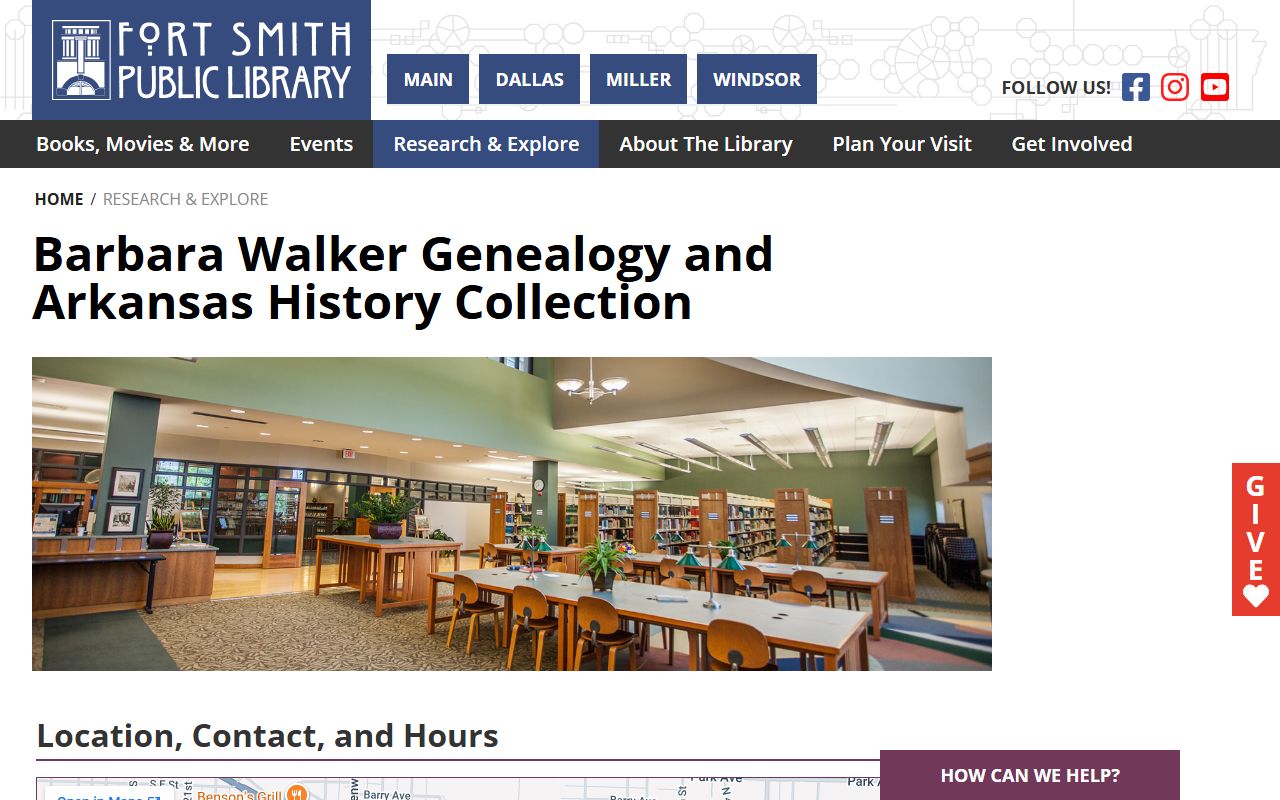
The Fort Smith Public Library's Barbara Walker Genealogy and Arkansas History Collection holds approximately 25,000 titles and is a FamilySearch Affiliate Library serving the Fort Smith area.
The library also holds digitized Fort Smith newspapers from 1848 to December 31, 1973. These newspaper archives are an important supplement to courthouse records, providing obituaries, legal notices, and family announcements that often fill gaps in the official record base.
Parker Court and National Historic Site
The Fort Smith National Historic Site at 301 Parker Avenue, Fort Smith, AR 72901, preserves the site of Judge Isaac C. Parker's federal court, which had jurisdiction over Indian Territory from 1875 to 1896. The Parker Court records are held at the National Archives at Fort Worth and are a significant genealogical resource for families in both Arkansas and what is now Oklahoma. Researchers with ancestors who had business before the federal court — including Indian Territory residents — should consult these records.
The Arkansas Department of Health holds birth and death records from 1914. For records before that date, the county courthouse holds early vital records from 1877 (births) and 1881 (deaths). The National Archives at Fort Worth, 501 W Felix Street, Fort Worth, TX 76115, phone (817) 831-5620, holds the Parker Court materials and federal census records.
Nearby Cities
Cities near Fort Smith with genealogy pages include Van Buren. Van Buren is the Crawford County seat directly across the Arkansas River and holds pre-1851 records for Fort Smith area families. Russellville is further east in Pope County along the Arkansas River Valley.